
For local businesses, generating consistent leads without overspending is one of the biggest challenges. Running Google Ads without a structured optimization strategy often leads to high cost per lead (CPL) and low return on investment. Smart Google Ads optimization allows businesses to get more qualified leads for the same budget, ensuring every advertising dollar works harder.
This article will cover practical strategies to reduce CPL for local service businesses, from understanding your audience to refining campaigns, improving ad quality, and leveraging landing pages effectively.
Understand Your Audience
Before launching any campaign, it is essential to know who your ideal customers are. Analyze demographics, locations, and search behavior. Focus on users who are most likely to convert—people actively looking for your service within your service area.
By targeting the right audience, you prevent your ads from showing to irrelevant users, reducing wasted clicks and lowering CPL. For local businesses, location-based targeting is especially critical to make sure your ads reach potential clients nearby.
Select the Right Campaign Type
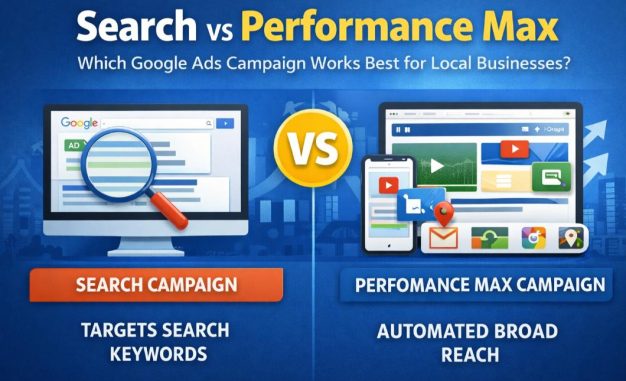
Google Ads offers multiple campaign types, including Search, Performance Max, and Display campaigns. Each serves a different purpose:
- Search Campaigns: Target users actively searching for services. High intent often results in better quality leads.
- Performance Max Campaigns: Leverage Google’s automation to reach potential customers across multiple platforms, including YouTube, Gmail, and Display Network.
- Display Campaigns: Useful for awareness, but usually less effective for immediate conversions.
Choosing the right mix of campaigns based on your business goals ensures efficiency and minimizes unnecessary spending.
Optimize Keywords and Match Types
Keywords are the foundation of your Google Ads performance. To lower CPL:
- Focus on specific service-related keywords rather than broad terms.
- Use location-specific keywords to attract local customers.
- Regularly review search terms to remove irrelevant queries.
- Test different match types (broad match modifier, phrase match, exact match) to control when your ads appear.
Optimized keywords reduce wasted clicks, improve relevance, and decrease the cost of acquiring a lead.
Improve Ad Quality and Relevance
High-quality, relevant ads receive higher Quality Scores, which directly affect cost per click. Strategies include:
- Writing compelling ad copy with clear benefits and calls-to-action.
- Aligning ad messaging with search intent and keywords.
- Highlighting unique selling points such as same-day service or free estimates.
Better ad relevance leads to lower CPL and increased ad performance over time.
Refine Bidding Strategies
Smart bidding strategies use Google’s machine learning to automatically adjust bids for maximum efficiency:
- Target CPA (Cost per Acquisition): Sets bids to achieve a specific cost per lead.
- Maximize Conversions: Automatically optimizes for the most conversions within your budget.
- Enhanced CPC: Adjusts manual bids to increase conversion potential.
Using the right bidding strategy ensures your budget is spent on users most likely to convert.
Continuous Monitoring and Testing
Ongoing optimization is crucial to maintaining low CPL:
- Test multiple ad variations to see which performs best.
- Experiment with different headlines, descriptions, and extensions.
- Monitor performance metrics such as conversion rate, CTR, and CPL.
- Adjust campaigns based on seasonal trends or new service offerings.
Regular monitoring allows you to make data-driven decisions that improve campaign performance over time.
Optimize Landing Pages for Conversions
Driving traffic to your website is only part of the equation. Converting that traffic into leads requires:
- Fast-loading, mobile-friendly landing pages.
- Clear calls-to-action and easy contact forms.
- Minimal distractions that could divert attention from the main goal.
- Highlighting trust elements like reviews, certifications, or guarantees.
A well-optimized landing page increases conversion rates, meaning more leads for the same ad spend.
Track and Measure Success
Proper tracking ensures you can evaluate campaign performance accurately. Use:
- Google Ads conversion tracking to see which campaigns drive leads.
- Google Analytics to monitor website behavior and conversions.
- Metrics like CPL, ROI, and conversion rate to identify areas for improvement.
Tracking allows businesses to identify what works, optimize campaigns, and maintain consistent lead generation at lower costs.
Final Thoughts
Lowering cost per lead requires a holistic approach that combines audience targeting, campaign type selection, keyword optimization, ad quality improvement, smart bidding, and landing page optimization. Local service businesses that implement these strategies consistently will see more qualified leads without increasing ad spend, making Google Ads a reliable growth engine.