
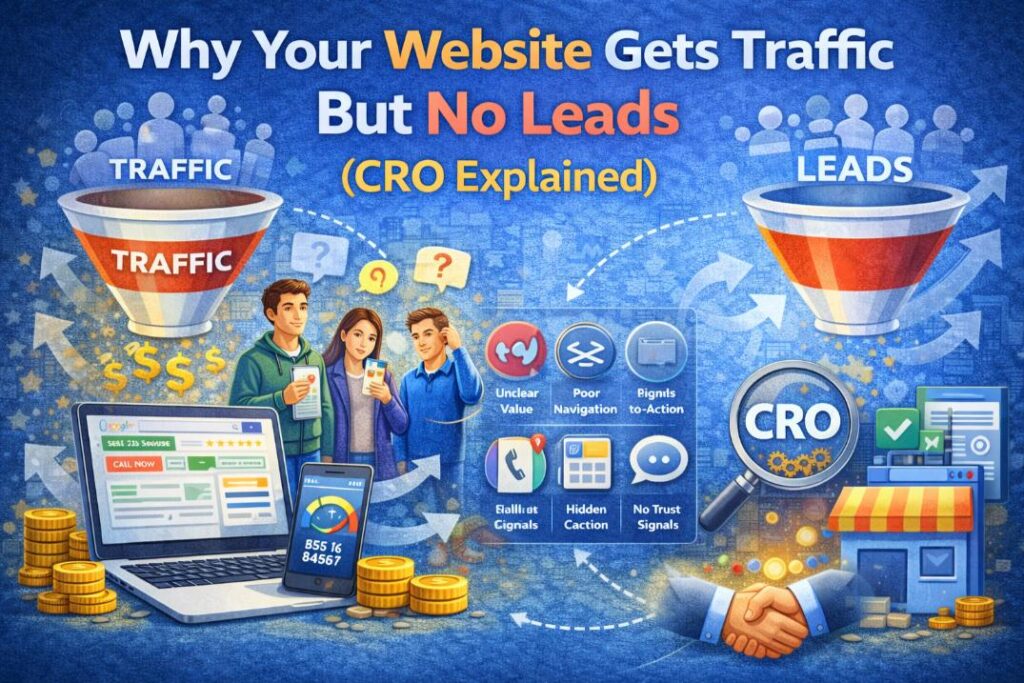
Many local service businesses invest in marketing strategies that successfully bring visitors to their websites. They run Google Ads campaigns, improve their search rankings, or promote their services on social media — yet they still struggle to generate calls, bookings, or inquiries.
If your website gets traffic but no leads, the issue is usually not visibility. Instead, it is often related to conversion performance. Conversion Rate Optimization (CRO) focuses on identifying the reasons visitors leave without taking action and improving the overall user experience to increase lead generation.
Understanding why this happens is the first step toward turning website traffic into real business opportunities.
The Gap Between Traffic and Conversions
Driving traffic to a website is only part of the growth equation. Without a conversion-focused structure, visitors may browse briefly and leave without engaging further.
Common reasons include:
- unclear messaging
- weak value proposition
- confusing navigation
- slow loading pages
- lack of trust signals
These issues create friction in the user journey, making it harder for potential customers to take the next step.
Unclear Value Proposition
One of the main reasons websites fail to generate leads is that visitors cannot quickly understand what the business offers. When messaging is vague or overly generic, users lose interest and continue searching for alternatives.
A clear value proposition should immediately communicate:
- what service you provide
- who you help
- why customers should choose you
Strong headlines and benefit-driven messaging help capture attention and increase engagement.
Poor User Experience and Navigation
Visitors expect to find relevant information quickly. If a website has complicated menus, cluttered layouts, or difficult navigation, users may become frustrated and leave.
A conversion-focused website ensures that service pages, contact options, and key information are easy to access. Simplifying the user journey reduces friction and increases the likelihood of generating inquiries.
Weak or Hidden Calls-to-Action
Even interested visitors may not convert if they are not clearly guided toward action. Websites that lack visible and compelling calls-to-action often fail to turn traffic into leads.
Effective calls-to-action include phrases such as:
- Request a Quote
- Call Now
- Book a Service
Strategic placement of these prompts throughout the website helps capture users at different stages of decision-making.
Slow Performance and Mobile Issues
Website speed and mobile usability have a direct impact on conversion rates. Many local searches happen on smartphones, and users expect fast, seamless browsing experiences.
If pages load slowly or are difficult to navigate on mobile devices, potential customers are more likely to leave and choose a competitor.
Optimizing performance and responsiveness ensures visitors stay engaged long enough to take action.
Lack of Trust and Credibility
Local customers often need reassurance before contacting a business. Websites that do not include trust elements may struggle to convert visitors.
Important trust signals include:
- customer reviews
- testimonials
- real project photos
- clear contact information
These elements build confidence and encourage visitors to move forward.
How CRO Helps Fix the Problem
Conversion Rate Optimization focuses on analyzing visitor behavior and improving website elements that influence decision-making.
By refining messaging, improving structure, enhancing performance, and simplifying contact processes, businesses can significantly increase the number of leads generated from existing traffic.
CRO transforms a passive website into an active lead generation system that supports long-term growth.
Final Thoughts
If your website receives traffic but fails to generate leads, the solution is not always more marketing. Often, the real opportunity lies in improving how your website converts visitors into customers.
For local service businesses, focusing on conversion optimization can lead to more calls, more bookings, and more predictable growth — without increasing advertising costs.